
- IP Core
- CAN 2.0A / 2.0B
- FIFO or AXI4-Lite
- DS791-compatible
- AMD & Microchip
Overview
The CAN Controller IP Core is a synthesizable VHDL design that implements a complete Controller Area Network (CAN) 2.0A/2.0B compliant controller for FPGA-based systems. The same field-proven protocol core is available in two integration variants:
- FIFO variant: communicates with the user logic via a FIFO style interface.
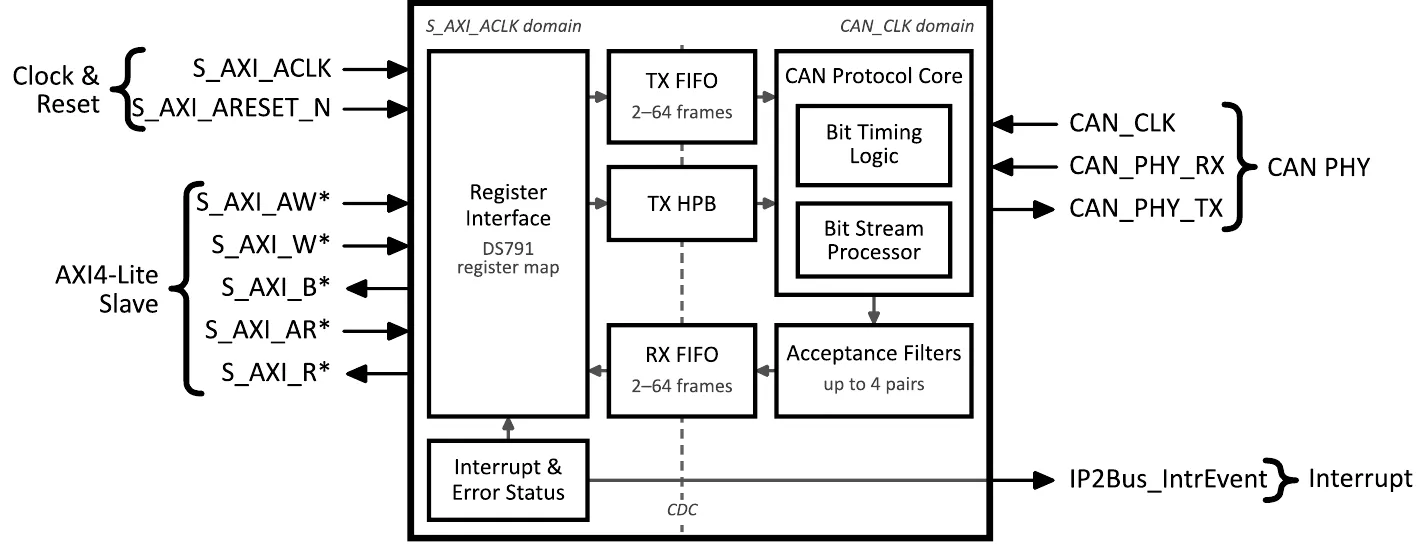
- AXI CAN variant: adds a 32-bit AXI4-Lite register interface and is designed as a register- and interrupt-compatible replacement for the AMD LogiCORE IP AXI CAN v1.03.a (DS791). It is delivered as a Vivado IP Integrator package and runs with the unmodified AMD XCan bare-metal driver.
Features
Protocol core (both variants)
- Compliant with Bosch CAN Specification 2.0 Part A and Part B
- Full support for CAN 2.0A (11-bit identifiers) and 2.0B (29-bit identifiers), data and remote frames
- Error handling, error frame generation, error counters, and Error Active/Passive/Bus-Off states
- Field-proven on FPGA platforms (AMD/Microchip) through customer deployments
FIFO variant
- Configurable bit timing via generics (prescaler, SJW, TSEG1, TSEG2, triple sampling)
- Works with external transmit and receive FIFOs
- 4 configurable ID filters can be set dynamically
AXI CAN variant
- DS791-compatible register map, reset values, and access behavior in a 256-byte AXI4-Lite address space
- Runtime bit timing through the BRPR/BTR registers
- Configurable TX and RX FIFOs (2 to 64 frames) plus a high-priority TX buffer
- Up to 4 acceptance filter mask/ID pairs for standard, extended, and remote frames
- Configuration, Normal, Sleep (with wake-up), and Loop Back modes
- 12 interrupt sources on a single interrupt line; ACK, bit, stuff, form, and CRC error status
- Independent AXI and CAN clocks (CAN_CLK 8–24 MHz) with built-in clock domain crossing
- Vivado IP Integrator package for 7 Series, Zynq-7000, and Zynq UltraScale+ MPSoC devices
- Runs with the unmodified AMD XCan driver (v3.11), validated on MicroBlaze
Interface
Figure 1: FIFO variant
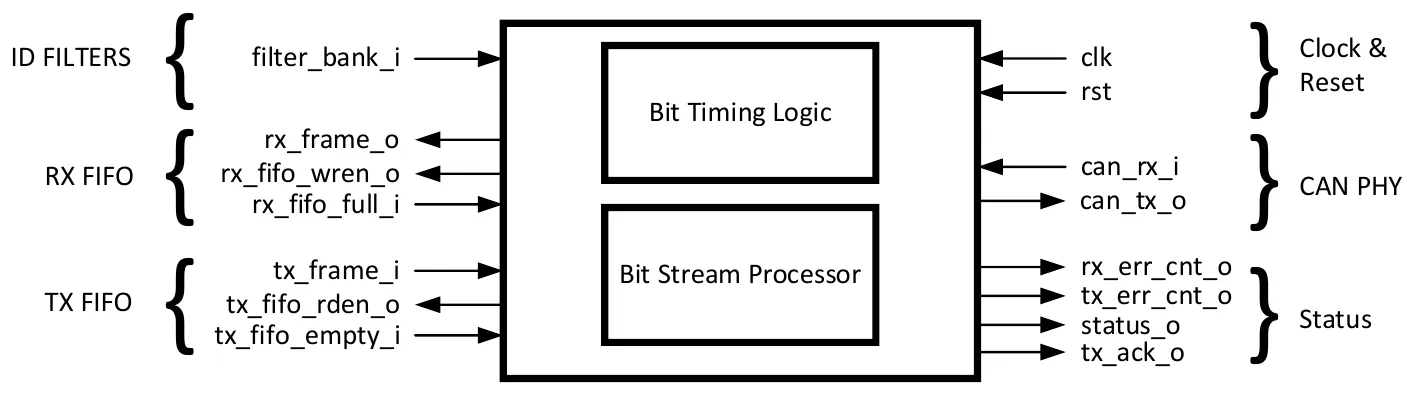
Figure 2: AXI CAN variant (S_AXI_AW*, W*, B*, AR*, R*: AXI4-Lite channel signals)
Resource Utilization
Table 1: Resource Utilization with Default Synthesis Configurations
| Variant | Device | Tool | Config. | LUT | FF | LUTRAM | BRAM |
|---|---|---|---|---|---|---|---|
| FIFO | Microchip PolarFire SoC | Libero SoC v2024.2 | – | 582 | 287 | – | – |
| FIFO | AMD Artix UltraScale+ | Vivado 2023.2 | – | 400 | 286 | – | – |
| AXI CAN | AMD Artix-7 | Vivado 2025.1 | 2/2/0 | 2010 | 1866 | 136 | 0 |
| AXI CAN | AMD Artix-7 | Vivado 2025.1 | 4/4/4 | 2733 | 3187 | 136 | 0 |
| AXI CAN | AMD Artix-7 | Vivado 2025.1 | 64/64/4 | 2885 | 3251 | 264 | 0 |
PolarFire figures are 4-input LUTs (4LUT) and DFFs. AXI CAN configuration = RX FIFO depth / TX FIFO depth / acceptance filter pairs (2/2/0 is the default); LUT totals include LUTRAM, no DSP blocks are used, and figures include the complete CAN protocol core.
Verification
- OSVVM-based self-checking regression: 30 test cases with over 27,000 checks
- AXI CAN suite passes identically on GHDL, Questa, and Vivado Simulator
- Independent compliance model for every DS791 register and reserved address
- All 12 interrupt sources covered; all 5 CAN error types injected at the CAN pins
- 98% line coverage on the AXI wrapper; CI regression on every change
- Routed Vivado implementation with timing met at 100 MHz AXI / 24 MHz CAN
Hardware Validation
FIFO variant
- Interoperability with PCAN-USB, MCP25625, STM32F3DISCOVERY and Kvaser USBcan Pro 2xHS v2
- AMD Artix-7 and Microchip PolarFire SoC platforms at 125 kbit/s, 500 kbit/s, and 1 Mbit/s
AXI CAN variant
Validated on an AMD Artix-7 (XC7A100T) with MicroBlaze and the AMD XCan driver, a TJA1051 transceiver, and a PEAK PCAN-USB node:
- Standard, extended, data, and remote frames in both directions at 125, 250, 500, and 1000 kbit/s
- Directed tests of FIFOs, high-priority buffer, filters, modes, and interrupts
- Error Passive, Bus-Off with automatic recovery, sleep/wake, and reset
- Stress: three long-duration runs at 500 kbit/s and 1 Mbit/s, each with 562,500 frames per direction and zero lost, duplicated, reordered, or corrupted frames
Deliverables
- Detailed Integration Guide: Clock/reset requirements, recommended FIFO selection, bit timing configuration examples, HW validated Vivado and Libero projects utilizing the IP
- AXI CAN IP Package: Vivado IP repository/ZIP with product guide, register map, and DS791 compatibility notes; HW validated Vivado/MicroBlaze reference design
- Verification & Validation Package: Test summary, functional and code coverage reports, hardware validation evidence (logs/screenshots & live online demo per request)
Interested in this IP core?
For quotation requests, licensing options and more information, contact us at info@anadologic.com.